
Air Density Calculator
Air density changes with temperature, pressure and humidity — and it matters for fans and HVAC airflow, drag and lift, engine power, wind turbines and ballistics. Enter the conditions to get the density of the air with the ideal gas law for moist air, plus the correction factors engineers and technicians use.
- Free to use
- No sign-up
- Runs in your browser
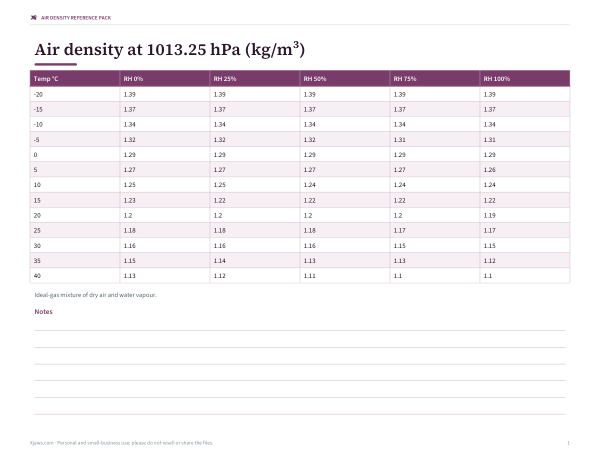
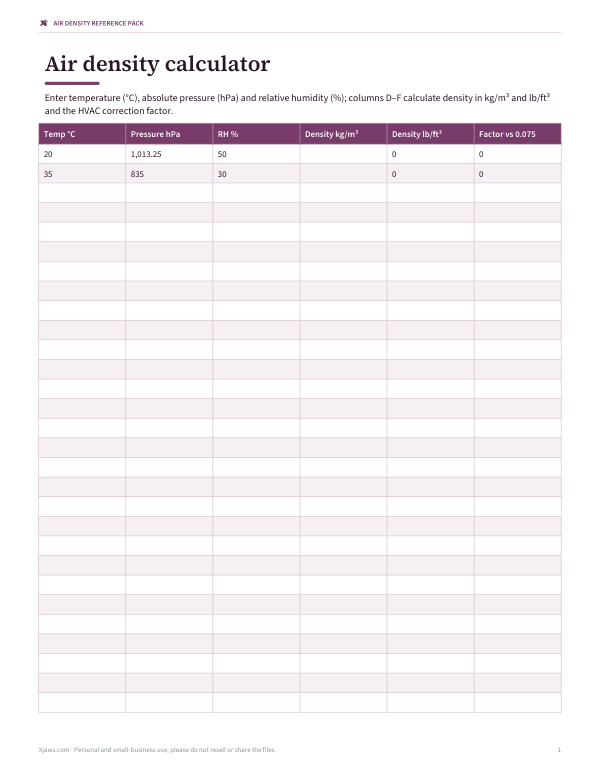
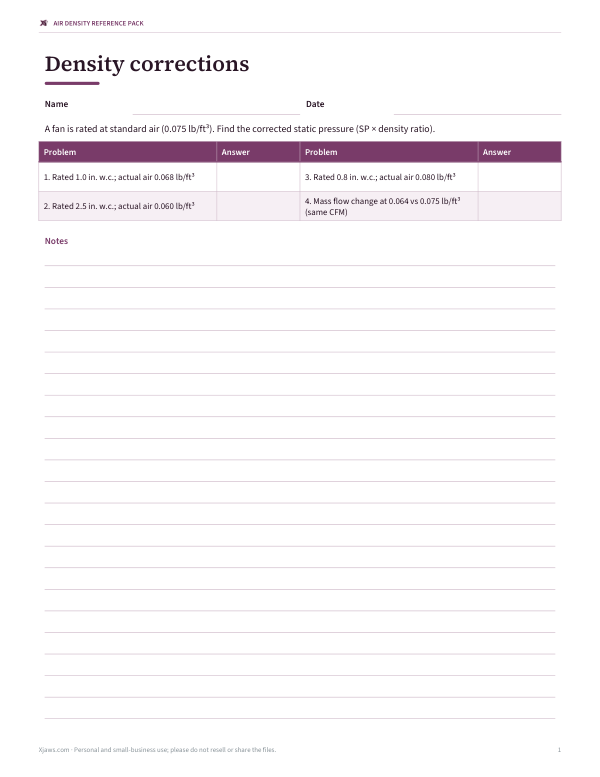
Air density calculator
Air Density Reference Pack
Printable air density tables by temperature, humidity and altitude, a spreadsheet calculator with humidity, and a fan and HVAC correction worksheet.
- Density tables (PDF/XLSX)
- Calculator (XLSX)
- Correction worksheet (PDF/DOCX)
Formats: PDF, XLSX, DOCX. Instant download after payment (link valid 72 hours, up to 5 downloads). AI-assisted: the templates were drafted with AI help and reviewed and laid out before publishing.
$3.00 USD, one-time 3 files · about $1.00 each
- Instant download
- 7-day refund
- Secure checkout by Stripe
7-day money-back guarantee. Full refund within 7 days of purchase, even after you download.
Full refund within 7 days — see the refund policy and license.
Free printables
Single sheets you can print right now, no sign-up. The full pack adds every sheet in one download plus the editable files.
The formula
| Step | Formula |
|---|---|
| Saturation vapour pressure | eₛ = 6.1078 × 10^(7.5T ÷ (237.3 + T)) hPa (T in °C) |
| Vapour pressure | pᵥ = eₛ × RH ÷ 100 |
| Dry-air partial pressure | p_d = p − pᵥ |
| Density | ρ = p_d ÷ (R_d T) + pᵥ ÷ (R_v T), with R_d = 287.058 and R_v = 461.495 J/(kg·K), T in kelvin |
This is the ideal gas law applied separately to dry air and water vapour. The vapour pressure formula (Tetens) is accurate to within a fraction of a percent for normal temperatures. For dry air, the calculation reduces to ρ = p ÷ (287.058 × T).
Air density at sea level by temperature
| Temperature | Dry air (kg/m³) | 50% humidity (kg/m³) | lb/ft³ (dry) |
|---|---|---|---|
| -20 °C (-4 °F) | 1.3943 | 1.3940 | 0.08705 |
| -10 °C (14 °F) | 1.3414 | 1.3406 | 0.08374 |
| 0 °C (32 °F) | 1.2922 | 1.2908 | 0.08067 |
| 10 °C (50 °F) | 1.2466 | 1.2438 | 0.07782 |
| 15 °C (59 °F) | 1.2250 | 1.2211 | 0.07647 |
| 20 °C (68 °F) | 1.2041 | 1.1988 | 0.07517 |
| 25 °C (77 °F) | 1.1839 | 1.1769 | 0.07391 |
| 30 °C (86 °F) | 1.1644 | 1.1552 | 0.07269 |
| 35 °C (95 °F) | 1.1455 | 1.1335 | 0.07151 |
| 40 °C (104 °F) | 1.1272 | 1.1117 | 0.07037 |
At 1013.25 hPa. Colder air is denser; humid air is slightly less dense than dry air at the same temperature and pressure, because water vapour molecules are lighter than nitrogen and oxygen.
Air density by altitude
| Altitude | Standard pressure (hPa) | Density at 15 °C (kg/m³) |
|---|---|---|
| 0 m (0 ft) | 1013.3 | 1.2250 |
| 500 m (1,640 ft) | 954.6 | 1.1541 |
| 1000 m (3,281 ft) | 898.7 | 1.0865 |
| 1500 m (4,921 ft) | 845.6 | 1.0222 |
| 2000 m (6,562 ft) | 795.0 | 0.9611 |
| 3000 m (9,843 ft) | 701.1 | 0.8476 |
| 4000 m (13,123 ft) | 616.4 | 0.7452 |
| 5000 m (16,404 ft) | 540.2 | 0.6531 |
Pressures from the standard atmosphere. Real pressure varies with weather by a few percent.
Worked example
In a room at 20 °C, 1013.25 hPa and 50% relative humidity, air density is about 1.1988 kg/m³. At a high-altitude site 1,600 m up (standard pressure about 835 hPa) on a 35 °C day at 30% humidity, it drops to about 0.9370 kg/m³ — roughly 22% less. A fan moving the same volume of air there moves 22% less mass, which is why HVAC and engine performance data are corrected for density.
Where air density matters
| Field | Why |
|---|---|
| HVAC and fans | Fan curves assume standard air (often 0.075 lb/ft³); mass flow and pressure scale with density |
| Aerodynamics | Lift and drag are proportional to density (½ρv²) |
| Wind energy | Power in the wind is proportional to density: ½ρAv³ |
| Engines | Naturally aspirated engines make less power in thin air |
| Ballistics and sports | Projectiles and balls fly farther in less dense air |
| Weather | Density differences drive convection and winds |
Specific volume and unit conversions
| Quantity | Relation |
|---|---|
| Specific volume | v = 1 ÷ ρ (m³/kg or ft³/lb) |
| kg/m³ to lb/ft³ | multiply by 0.062428 |
| lb/ft³ to kg/m³ | multiply by 16.0185 |
| Standard HVAC air | 0.075 lb/ft³ ≈ 1.201 kg/m³ (13.33 ft³/lb) |
| ISA sea level | 1.225 kg/m³ ≈ 0.0765 lb/ft³ |
HVAC engineers often work with specific volume from a psychrometric chart; aerodynamicists use density directly. Both describe the same property.
Wind power example
The power in the wind passing through a turbine’s rotor is ½ρAv³. For the same wind speed and rotor, a site where air density is 1.10 kg/m³ has about 10% less power available than a sea-level site at 1.225 kg/m³. That’s why wind turbine power curves are specified at a reference density and corrected for high or hot sites.
Common mistakes
- Using gauge pressure instead of absolute pressure.
- Using the sea-level-corrected altimeter setting instead of actual station pressure at altitude.
- Forgetting to convert °C to kelvin in the ideal gas law.
- Ignoring humidity in hot, humid conditions, where it changes density by 1–2%.
Privacy
All calculations run in your browser.
Frequently asked questions
What is the density of air?
About 1.225 kg/m³ at sea level and 15 °C (standard atmosphere).
How does temperature affect air density?
Warmer air is less dense — about 0.4% less per °C near room temperature.
Does humidity increase air density?
No — humid air is slightly less dense than dry air.
What is standard air in HVAC?
0.075 lb/ft³, roughly dry air at 70 °F and sea-level pressure.
What is dynamic pressure?
q = ½ρv², the pressure associated with moving air.
Can I use altitude instead of pressure?
Yes — choose altitude and the standard-atmosphere pressure is used.
What is the density of air at 20 °C?
About 1.204 kg/m³ for dry air at sea-level pressure.
Why is humid air lighter?
Water vapour (18 g/mol) is lighter than the nitrogen and oxygen (about 29 g/mol average) it displaces.
Is air density the same as air pressure?
No — pressure is force per area; density is mass per volume. They are linked through temperature.
How accurate is the calculation?
Within a fraction of a percent for normal conditions, using the ideal gas law.
Does air density change with weather?
Yes — pressure systems and temperature changes shift it by a few percent from day to day.